There are three different revenue streams that can be explored through this coordination. The first is the participation in the day-ahead electricity market, where energy is bought and sold for the following day, so that sites charge when energy is cheap and solar is plentiful. The second is ancillary services such as mFRR, a reserve that the national grid operator calls on to keep electricity supply and demand in balance. The third is flexibility services for the DSO, which can use local flexibility to manage its network. A single car park is too small for most of these, so an aggregator pools the sites. All of this must happen without getting in the way of drivers who need their car.
What innovative technologies or solutions are being demonstrated?
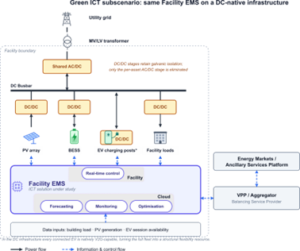
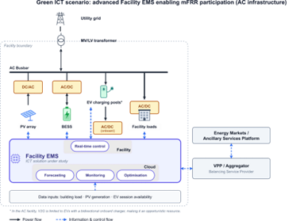
Each site combines solar panels, battery storage and EV chargers, coordinated by an energy management system that decides when to charge the battery, and when to exchange energy with the grid, while an aggregator coordinates the sites as one group. One feature being demonstrated is Happy Hour: when there is plenty of cheap solar energy, EV owners receive a benefit for charging during those periods.
In the laboratory, the pilot demonstrates DC infrastructure with Power Hardware-in-the-Loop: real power equipment connected to a computer model of a site, so that AC and DC infrastructures can be compared directly on how well they let EVs offer flexibility to the grid.
What are your main objectives?
The pilot aims to show that smart management can lower the operating cost of these sites and let them offer flexibility to the grid through aggregators. The project targets at least 25% lower operating cost compared with non-optimal operation, and at least a doubling of participation in flexibility services.
The pilot will also indicate how AC or DC infrastructure compare financially for such sites and how it scales with EV charging network size. The expected impact is practical guidance for owners of public car parks on turning EV charging from a cost into a resource.
What progress has been made so far?
The pilot is in its early phase. The team has defined how the sites will take part in different grid services and markets. Évora already has solar panels and a battery installed, while Matosinhos and Amadora are expected to install their batteries during the pilot.
Looking ahead, what are the next steps?
The coming months bring four activities. Happy Hour will continue to be developed. Computer models of the sites will be built, and data will be collected from them and used to tune the energy management systems. Then the models will be commissioned in the laboratory on the Power Hardware-in-the-Loop platform, so the AC and DC designs can be compared.
What are the possible implications for the large-scale adoption of ePIPV?
The approach can be repeated at any site with a car park, solar panels and a battery, such as supermarkets, offices and campuses. Rules and markets differ between countries, so what needs adapting is how each site connects with grid services. Site owners benefit from lower costs, charging operators from new services, grid operators from flexible resources that help keep the grid stable, and drivers from advantages such as Happy Hour.