Throughout the upcoming months, we will be publishing a series of interviews with each of our ten pilots to offer a peek behind the scenes of the exciting technological developments happening in the context of the SOLAR-MOVE project.
Next up is Greece, showing how municipal PV-integrated EV charging stations can help optimise the use of solar energy and reduce grid dependency.
Can you briefly introduce the organisations involved?
DAEM – City of Athens IT Company – providing the municipal assets for the Athens pilot implementation.
NTUA – providing the technical support and development as well as research aspect.
Can you describe your pilot in a few sentences?
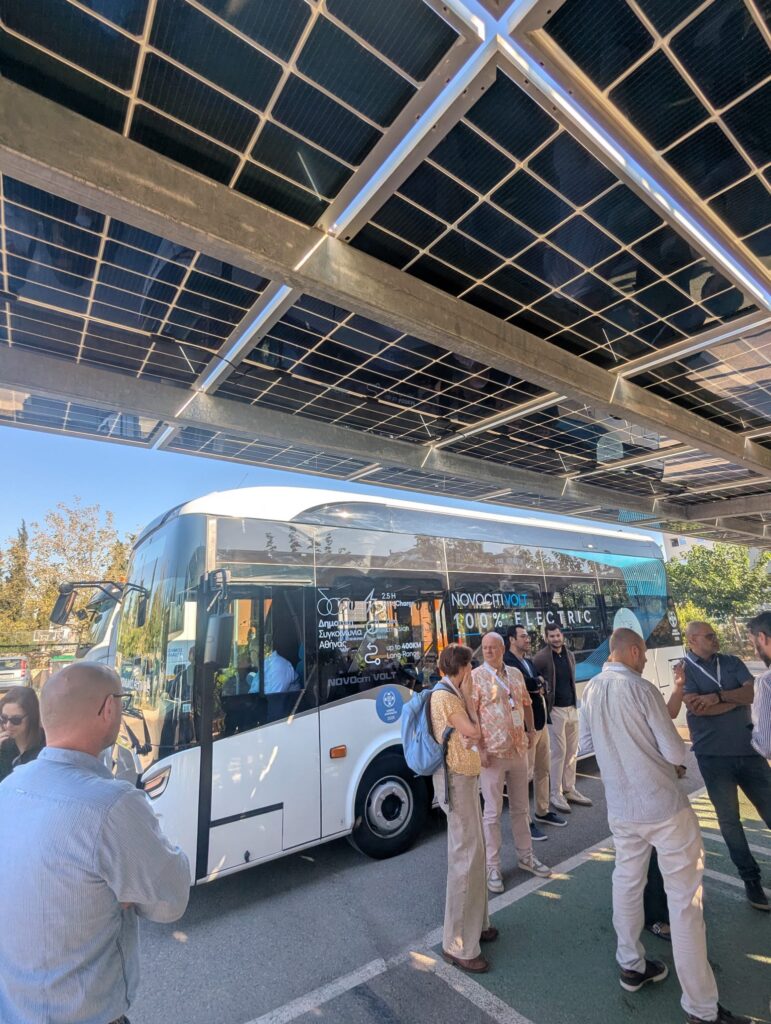
The Athens pilot demonstrates the management of PV systems interconnected with EV charging stations in areas of the City of Athens. The pilot takes place in the Serafeio Complex of Athens. The aim is to test innovative methodologies for PV integrated management and the utilization of solar energy at optimal level.
What challenges does the pilot aim to address?
The pilot tackles challenges related to the effectiveness of PV interconnected with in order to support EV optimisation. Also the pilot experiments on the management of the charging process based on the availability of solar power and the timeslot EV maximum demand and finally the dynamic adjustment of charging rates as well as the dynamic scheduling charging sessions to maximise the use of solar energy.
Greece Pilot at a Glance
- Country: Greece
- City: Athens
- Pilot type: ePIPV
- Lead organisation: DAEM
- Main technology: PV charging stations
- Key objectives: Research on coordination of charging stations with PV production
- Expected duration: 27 months
- Main stakeholders: DAEM, NTUA, City of Athens
What innovative technologies or solutions are being demonstrated?
The innovative solutions demonstrated include PV-integrated charging, smart charging, efficiency on energy management through the use of digital tools, as well as forecasting and optimisation.
What are your main objectives?
The Athens pilot will research on the scheduling patterns that maximize the use of solar energy, in order to achieve reduction on grid dependency and also to evaluate the effectiveness of PV charging stations in supporting EVs. The impact of the pilot will showcase proof of concept for a European city with relevant infrastructure and the scalability of the SOLAR MOVE solution.
What progress has been made so far?
Currently the Athens pilot has progressed on the installation and integration activities, hence two AC chargers have been installed in Serafeio Complex and solar panels are providing daily charging energy. The administration of EV charging within the City of Athens is already taking place through an online App for users and platform for the city developed by DAEM.
Looking ahead, what are the next steps?
The next steps foreseen the inclusion of a fast DC EV charger to be delivered and installed in the demonstration site of the Athens pilot.
What are the possible implications for the large-scale adoption of ePIPV?
The results could potentially be replicated to the whole network of EV charging for Athens.